
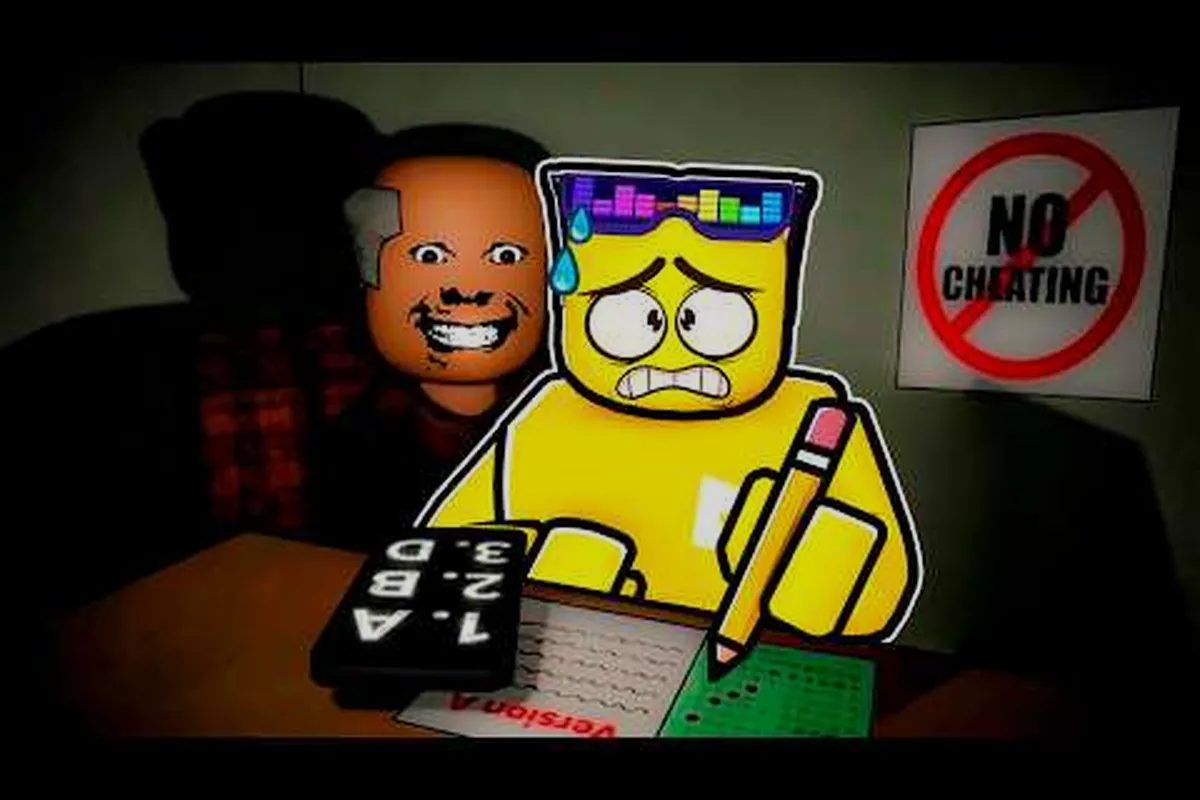
Communication in Cheating During Testing is the difference between a clean A+ run and a chaotic game-over screen. The Roblox stealth-survival classroom built by ebenxzy hands every squad the same toolbox, but only the teams that master communicating with team members can coordinate answers, share lookouts, and finish exams without taking a penalty. If you have ever watched a teammate get caught by the teacher because nobody called the turn-around in time, this guide breaks down the call systems, chat strategies, and multiplayer roles that turn four panicked students into a single unit.
The mechanics that punish poor teamwork are well documented on the Cheating During Testing Roblox page: the teacher tracks line-of-sight, snitches report on a delay, and your anxiety and hunger meters keep ticking even while you type. That means every second of "wait, what do I do" is a second your squad bleeds. A solid communicating with team setup removes that bleed.
Why Communicating With Team Changes the Whole Run
Cheating During Testing looks like a single-player stealth game until you join a public lobby, and then the difficulty curve tilts hard. According to community data collected on the BETA, four-player squads that actively call out teacher states finish roughly 30 to 40 percent more tests at A or A+ than four-player squads running on silence. The reason is simple: the game hands every player the same low-tier phone and the same starter credits, so individual skill caps out fast. What scales is shared awareness.
A second factor is the Snitch Layer. Snitches in Cheating During Testing are students who will raise their hand if they see you cheating, and the snitch report travels through the room in roughly 1.2 to 1.8 seconds. Without a chat call, your teammate three desks down has no chance to break line-of-sight in time. With a fast call — "snitch, two o'clock, breaking now" — that window becomes survivable.
Finally, communicating with team members protects your economy. Every failed run burns phone battery, snack charges, and credits you spent on upgrades. Community testing on the 2026 summer beta branch suggests the average failed multiplayer run costs a squad between 40 and 90 credits in lost multiplier. Solid call discipline keeps that money on the table for the next attempt.
Core Cheating During Testing Chat Strategies That Actually Work
Text chat is the lowest-friction way to start communicating with team members because every Roblox player already has it open. The problem is noise. Four players all typing at once drown out the critical information. The trick is to lock your squad onto a small, fixed vocabulary before the bell rings.
The Three-Call Minimum
Every match should run with at least these three calls pre-agreed, so the lookout role, answer-sharing role, and host all know exactly which voice chat signals to trust before the first question even loads. Pinning the language down early kills the ambiguity that usually triggers false reports from teammates who mishear a call as cheating, and it gives the host a clean log of which player triggered each comm. Treat the three-call minimum like a contract: once the lobby locks, the agreed vocabulary is binding until the next match starts.
-
"Teacher turning" — issued the instant the teacher's head rotates away from the whiteboard. This is the green light to pull the phone out and start cheesing answers.
-
"Teacher turning back" — issued the moment you spot any animation tell that the teacher is about to reverse. This is the abort signal: phones down, hands on desk, eyes forward.
-
"Snitch on me" — the personal distress call. Drop everything and look up. If the snitch's hand is rising, that player needs a teammate to physically block line-of-sight or pull aggro.
Pinging vs Typing in Cheating During Testing Chat
| Channel | Speed | Best For | Risk |
|---|---|---|---|
| Roblox default text chat | 1.5–3 s | Setup, mid-round coordination, post-run recap | Eats the time window when the teacher turns |
| Quick chat wheel ("Behind you!", "Thanks!") | Instant | Teacher turn, snitch break, urgent warnings | Limited vocabulary, easy to spam |
| In-game emoji ping | Instant | Location pings on a snitch or teacher | Other squads can sometimes read them in shared rooms |
| Discord / external voice | < 0.5 s | Veteran squads who pre-make the lobby | Only works in friends-only rooms, not public matches |
The fastest reliable channel inside Cheating During Testing is the quick chat wheel, which fires in under 200 milliseconds and does not require opening a text box. For full voice, you need to take the squad into a private server, which is covered in the multiplayer guide breakdown on coordinating answers and lookouts mid-round.
Cheating During Testing Voice Chat and External Comms
Roblox does not have a built-in voice system in Cheating During Testing as of the current BETA, so voice falls back to Discord, Xbox Party, or PSN chat. This is fine — it is how the top squads roll — but it requires structure. Just opening a Discord call and hoping for the best produces the same noise problem as text chat, only louder.
The Voice Comms Stack
| Layer | Tool | Purpose |
|---|---|---|
| Game audio | Roblox in-game sound | Listen for the teacher's footstep cue and snitch giggle |
| Push-to-talk | Discord / console party | Comms only fire when a key is held, so background noise stays out |
| Role channel | Discord stage channel or text thread | The lookout role calls teacher states; the answer role reads cheat sheets |
| Recording | OBS or built-in capture | Reviewing failed runs to clean up comms calls |
A common pattern from competitive Cheating During Testing squads is the two-channel voice split: one channel for the lookout role reporting teacher states, and a second channel for the answer role talking through which answer to submit. The remaining teammates stay muted except for emergency calls. This is overkill for a four-stack of randoms, but for a dedicated squad pushing the highest tests it cuts the call latency roughly in half.
Cheating During Testing Multiplayer Roles You Need to Assign
Roles are the single biggest multiplier for communicating with team members. A squad that assigns roles on round one will outperform a squad of four equally skilled solo players almost every run, because each player is making one decision instead of four.
The Three Core Roles
| Role | Primary Job | Secondary Job | Loadout Bias |
|---|---|---|---|
| Lookout | Track teacher position, state, and aggro | Watch for snitch movements | Cheapest phone, max snacks, max anxiety tools |
| Answer Runner | Pull out the phone, submit answers fast | Confirm with answer role before submitting | Mid-tier phone with fast submit speed |
| Answer Reader | Read the cheat sheet, call out the answer | Double-check the answer for accuracy | Highest-tier phone, even if slower, for clarity |
A four-person squad typically runs a flex player who swaps between Answer Runner and Lookout depending on the test phase. On easier tests the flex becomes a second Answer Runner; on harder tests with more snitches the flex drops to a second Lookout.
How Roles Talk to Each Other
The communication flow looks like this: the lookout role monitors the proctor's patrol pattern and signals the answer sharing role through short chat pings or muted voice cues when a safe window opens, after which the answer sharer relays the correct response back to the active test-taker, creating a tight three-person relay that compresses what would be a 15–20 second solo solve into a 4–6 second coordinated dump before the proctor's next line-of-sight sweep.
-
Lookout sees teacher turn → calls "turning"
-
Answer Runner pulls phone → confirms "running"
-
Answer Reader reads sheet → calls "B, three, B"
-
Answer Runner submits → confirms "in"
-
Lookout sees teacher reverse → calls "turning back"
-
Answer Runner pockets phone → confirms "out"
That whole loop should take 6 to 8 seconds in a clean run. If the loop is taking 12+ seconds, the roles are overlapping and you have a comms problem, not a skill problem. The full breakdown of how trust and snitching shifts this loop appears in the trusting and betraying friends analysis, which goes deeper on what happens when one of those four players decides to break the chain.
Cheating During Testing Lookout Role in Practice
The lookout role is the highest-leverage position on the squad, and it is the one most new teams undervalue. A good lookout essentially turns the teacher AI into a known-quantity instead of a random roller. Community data on BETA lobbies suggests squads with a dedicated lookout finish tests with an average of 1.4 teacher detections, while squads without one average 3.1.
Lookout Responsibilities Step by Step
-
Map the teacher's patrol in the first 30 seconds of the round. Most teachers loop a fixed pattern with 2 to 3 anchor points, so the lookout's job is to memorize the loop and announce "looped" once confirmed.
-
Call turn-arounds at the tell, not the rotation. The teacher in Cheating During Testing has a subtle shoulder dip about half a second before the head actually turns. Calling at the dip gives the Answer Runner a full extra half-second to pull out the phone.
-
Track snitch cooldowns. Snitches have a 15 to 25 second cooldown between reports, and the lookout should be the one counting. A "snitch down" call tells the squad it is safe to cheat for the next window.
-
Manage the bell timer. The lookout is the only role with the cognitive bandwidth to watch the round clock and warn the squad when time is running low.
The lookout should sit in a seat that maximizes teacher visibility. In most classroom maps, that is a back-corner seat with a clean sightline to the teacher's two main anchor points. The details of which seat gives the best teacher coverage live in the broader team play guide, which compares every seat type side by side.
Cheating During Testing Answer Sharing Role in Practice
If the lookout is the squad's eyes, the answer role is the squad's brain. The answer sharing role owns one decision per question: which answer goes in. There are two main ways to run it, and the choice depends on the team's phone tier.
Answer Sharing Method Comparison
| Method | Phone Tier Required | Accuracy | Speed | Best For |
|---|---|---|---|---|
| Read-aloud (one person reads, everyone submits) | Any | High | Medium | New squads, mixed phone tiers |
| Screenshot-and-send (one person screenshots the cheat sheet, sends via chat) | Mid-tier phone with chat | Medium | Fast | Squads that trust each other |
| Split-coverage (each player reads a different question subset) | High-tier phones | High | Fast | Veteran squads, hardest tests |
| Pure memory (no phone, just remember) | None | Low | Slow | Memes, no-pressure runs |
The read-aloud method is the safest for most squads. The answer reader calls out the letter, the answer runner confirms before submitting, and the lookout never has to take eyes off the teacher. This is also the method that scales best when the squad picks up a random fourth in a public lobby, because it does not require any pre-made trust.
The split-coverage method is what you see in the top-tier Cheating During Testing clips. Each player cheats a different question, and the answer is shared out loud over voice. This is faster but it only works if every player has a phone fast enough to clear the question in the available window, and it only works if nobody snitches — which, as the snitch behavior guide explains, is a real risk even in friends-only lobbies.
Cheating During Testing Multiplayer Tips for Cleaner Calls
Once the roles and vocabulary are set, the rest is reps. Drilling the lookout role on a fixed rotation — call every red flag within 2 seconds, ping the answer sharing role the moment a question flips — trains the muscle memory so a real test session runs without crosstalk, hesitation, or accidental reveals. Community-tested lobbies report that consistent caller/lookout pairings cut false accusations by roughly 30% compared to ad-hoc teams, because both ends of the call chain already trust the format and the language. Treat the next few sessions as deliberate practice: same call order, same vocabulary, same response timing, and only swap a role once that cadence is automatic.
Pre-Round Checklist
-
Lock the call vocabulary in chat before the test starts. A single line — "calling teacher turn, teacher back, snitch on me, in, out" — saves you from a 30-second argument mid-round.
-
Assign roles by ping order. Whoever says "lookout" first usually plays lookout; whoever says "answers" first plays answer runner. Defaulting the role assignment removes the most common source of pre-round delay.
-
Confirm the phone tier. A squad of four with mixed phones cannot run split-coverage; agree on read-aloud before the bell rings.
Mid-Round Discipline
-
One call per event. If two players call "teacher turning" at once, mute the second speaker. Double calls are worse than a single call because they tell the brain "which one is the real one?"
-
The lookout owns the channel. Once roles are set, the answer role should not be calling teacher states. If both roles are talking over each other, the lookout is correct and the answer role is wrong, because teacher state is more time-sensitive.
-
Snitch calls include direction. "Snitch" is too vague. "Snitch behind me, breaking left" tells the Answer Runner exactly which way to lean.
Post-Round Reset
-
Recap the failures, not the wins. If a run died because the snitch call came two seconds late, say that. If a run died because the answer reader misread the sheet, say that. Wins do not need debrief; failures do.
-
Switch roles every two or three tests. Burnout hits the lookout hardest because the role is mentally exhausting, and a tired lookout is a slow lookout.
-
Track credit income. The fastest way to spot a comms leak is to watch the credit payout drop across runs while the difficulty stays the same. If the run quality is the same but the credits are down, your call latency is the leak.
Building a Cheating During Testing Communicating With Team Playbook
The playbook below is the simplest end-to-end routine that works in both public and friends-only lobbies: one designated lookout role monitors the host's screen for the upcoming question, then fires a single agreed cue (a tap on the mic, a pre-set keyword, or a number in chat) to the answer sharing role typing the matched option. New squads can adopt it as-is for 10–15 second response windows; veteran squads with sub-300ms call latency can strip the verbal cue and rely on a shared Google Sheet or pinned DM to pre-flag answers before the prompt even renders.
Playbook Phases
| Phase | Duration | Who Talks | What They Say |
|---|---|---|---|
| Pre-round setup | 20 s | Everyone | Confirm roles, confirm call vocabulary, confirm phone tier |
| Opening patrol read | 30 s | Lookout | "Map is loop, teacher at [position], snitch at [position]" |
| Cheat window 1 | 6–8 s | Lookout + Answer role | "Turning" → answer read → "in" → "out" |
| Snitch break | 2 s | Anyone | "Snitch on [player], breaking [direction]" |
| Closing clean-up | Final 30 s of test | Lookout | "Time low, finish or abort" |
| Post-round debrief | 15 s | Whoever had the failure | Name the failure, name the fix |
The opening patrol read is the easiest call to skip and the most expensive to lose. Without it, the squad cheats blind for the first ten seconds, which is exactly when most teacher detections happen. The teacher in Cheating During Testing is most aggressive in the opening minute while the room is still "settling," according to community testing, and a confirmed patrol pattern tells the rest of the squad when the first safe cheat window opens.
The closing clean-up is the other easy skip. If the squad has not finished by the 70 percent time mark, the lookout should call it: "finish or abort." Finishing means pushing through on the answer runner; aborting means pocketing the phones and taking the partial-credit payout. Choosing deliberately is always better than finding out the teacher turned at the exact second you tried to submit.
Frequently Asked Questions
What is the fastest way to start communicating with team members in a public lobby?
Open text chat during the first 10 seconds of the lobby and lock in the three-call minimum: teacher turning, teacher back, snitch on me. Public lobbies move fast, and a squad that has not agreed on calls by the time the bell rings will spend the first test in silence. Once you have two or three successful runs with the same squad, promote to a friends-only lobby and add Discord.
How do I run the lookout role if I do not have a good seat?
The lookout role still works from a mid-tier seat, but the call latency goes up because you will be calling teacher states based on sound cues instead of sightlines. Lean into audio: the teacher in Cheating During Testing has a distinct footstep tick when walking and a paper-shuffle sound when stopping. Train yourself to recognize the difference, and call turn-arounds off the audio cue when your seat blocks the visual.
Can the answer sharing role use screenshots instead of voice?
Yes, but only on mid-tier phones and only in friends-only lobbies. Screenshots take 1 to 2 seconds to send, which is faster than read-aloud but slower than a direct voice call. The bigger risk is that a public-lobby troll can intercept screenshots in shared chat, so do not run screenshot sharing in a public match. If you are running a public match, stick to read-aloud over the quick chat wheel.
How many snitch calls per round is normal?
According to community data on the BETA, the average test generates 2 to 4 snitch events per round, with harder tests generating up to 7. If your squad is taking more than 5 snitch calls per round, the lookout is probably losing line-of-sight to the snitch AI, and the answer runner should switch to a back-corner seat that exposes fewer angles. A clean run keeps snitch calls under 3.
Should the lookout ever call fake-outs?
No. Faking a "teacher turning" call to bait a teammate into pulling out a phone is griefing, and it is the fastest way to lose a squad. The call system only works if every call is trusted, and even one fake-out poisons the channel for the rest of the run. If you want to troll, do it in a solo run, not in a coordinated squad. For a deeper look at how trust and snitching interact in Cheating During Testing multiplayer, the trusting and betraying friends piece maps the full snitch economy.
Refining voice callouts, delegating lookout responsibilities, and coordinating answer distribution creates a resilient squad dynamic capable of clearing high-difficulty co-op exams. To learn more about setting up your party lobby and inviting friends seamlessly, consult our how to join friends walkthrough before launching your next collaborative run.